

Churning Through Time: Antique Butter Churns

Explore the history and value of antique butter churns—from plunge to barrel—and find unique pieces at Cookstown Antique Market.
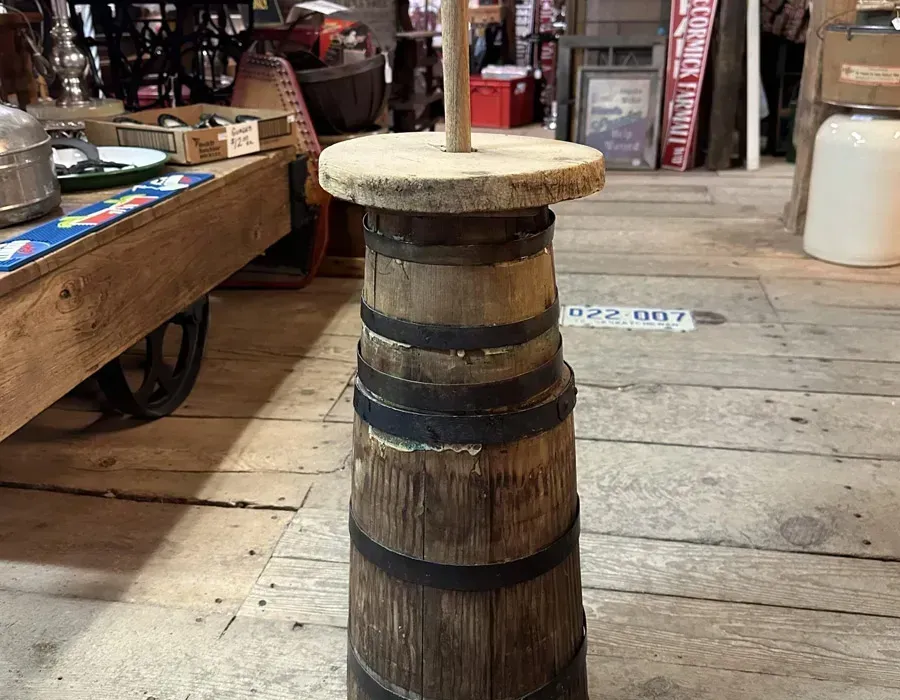
Antique butter churn

APRON on and dash in hand,
O’er the old church her I stand-
           Cachug!
How the thick cream spurts and flies
Now on shoes, and now in eyes!-
            Cachug! cachug!
Rich flakes cling to lid and dash:
Hear the thin milk’ s watery splash!-
            Cachug!
Sweetest music to the ear;
For it says the butter is here!-


This is part of one song created by Silas Dinsmore of Texas that women used to sing to while away the time as they carried out the time-consuming task of transforming thick cream into butter. And yes in the pioneer days, women were the ones who stood, or sat, before a wooden cylinder-like contraption, moving a plunger up and down for an hour or more until butter was formed.

Plunge Churn

The contraption used by these women was known as a butter churn, a device that has its roots in Europe as early as the 6th century AD. The most common and most recognizable butter churn used was the plunge churn that was used from the Middle Ages until the beginning of the Victorian era. It consisted of a wooden cylinder with a removable lid. The lid had a round hole through which a wooden pole, known as a plunger, also known or dash, was inserted, allowing the operator to perform the up and down churning motion.

Paddle Churn

Innovation and the advancement of technology eventually saw the plunge churns being replaced with the paddle churn, a somewhat easier but still a manually operated churn. This device consisted of a container made from wood, ceramics, galvanized iron and even glass with a lid that was securely affixed to the container. A crank handle on the top of the lid was attached to a paddle inside the container. When the crank was turned, the paddle would agitate quickly through the cream, breaking up the cream by mixing it with air producing butter faster than with the plunge churn.

Barrel Churn

Another innovation in butter producing devices was the barrel churn. First used in the 18th century, it was a little more sophisticated than the plunge and paddle churns. In this case, a wooden barrel was turned on its side and was attached to a metal, cast iron or wooden stand with a crank. When the crank was turned, a paddle inside the churn turned or, alternatively, the whole barrel turned vertically or horizontally to agitate the thick cream and transform it into butter faster than the plunge churn.

Other variations of the barrel churn swung or rocked rather than being turned to perform the butter making process.

Rocking Chair Churn

One innovative type of butter churn was the rocking chair butter churn that was invented by American Alfred Clark. A simple device, it consisted of a barrel attached to a rocking chair. As the chair rocked it churned the cream into butter.

The value of an antique butter churn can range from $25 to more than $500 with the price being determined by various factors, including the type of churn, the materials used to make it, how old it is, colour, style and, of course, the condition.

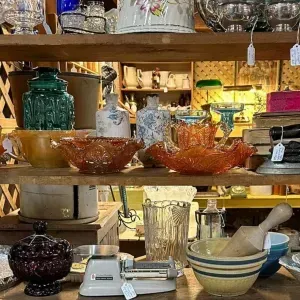
You might find some samples of butter churns along with other among the quality antiques and vintage items available from 35 dealers at the Cookstown Antique Market on Highway 27 in Cookstown, Ontario. Decorators, collectors and the casual enthusiasts can browse through the 6,000 square foot century old barn for that special purchase.

Share the Post:

Related Posts